You Know What You Earned Last Month. Do You Know What Earned It?

Every business account you follow says the same thing: add another income stream. None of them mention what happens after you do.
You add one. Then a second. The monthly total goes up, which feels like proof it worked — and somewhere in there you quietly lose the ability to say which part of the work is actually paying you. You still know what you made. You’ve stopped knowing what made it.
The next update adds a Revenue screen that answers that question, sorting every payment by where it came from and showing you the split.
One number is not an answer
Two months from the same nail tech’s records:
- March — $4,150. Every dollar of it from services. 112 hours at the desk.
- August — $4,150. $2,780 from services, $1,050 from one teaching day, $210 from products she resells, $110 from a short course she recorded back in spring. 87 hours.
Identical totals. Two different businesses. She earned the same money in August with 25 fewer hours of work — three full working days — and if all she ever sees is $4,150, she has no idea that happened.
March has a hard ceiling built into it, because it’s capped by the number of hours a human being can stand up and work. August isn’t capped the same way. That difference is invisible in the total and obvious in the split.
A total tells you how the month went. Only the split tells you whether you can do it again.
The stream you think is small usually isn’t
Ask a solo pro to rank their income sources from memory and the ranking usually comes out wrong. Not from carelessness. A stream’s size in your head gets set by how much attention it demanded, not by how much it paid.
Look at what that August actually contained:
- The teaching day felt like a side quest. One Saturday, eight people in a rented room, slides finished at midnight. It brought in $1,050 — a quarter of the month.
- Product resale felt like real money. She recommends products daily, restocks constantly, thinks about margins in the shower. It brought in $210 — five percent.
- The course felt dead. Nobody had mentioned it since June. It brought in $110 while she wasn’t looking.
None of those three feelings matched the number attached to it. The one she’d have ranked second was fourth. The one she nearly cancelled was second.
Attention is a bad proxy for income. The stream that lives rent-free in your head is rarely the one funding your month.
Then divide by the hours
The split by amount is the first surprise. The split by hour is the one that changes decisions:
- Services — $2,780 across 75 hours. About $37 an hour.
- Teaching — $1,050 across 9 hours, prep included. About $117 an hour.
- Resale — $210 across roughly 3 hours of ordering, unpacking and restocking. About $70 an hour.
- The course — $110 across zero hours. Recorded in spring, sold in August, no work performed this month at all.
The order reverses. Services are 67% of the money and 86% of the hours. Teaching is 25% of the money and 10% of the hours.
Put concretely: another nine hours of teaching is roughly $1,050. Another nine hours at the desk is roughly $333.
That is not an argument for dropping clients. Services pay her rent, and they’re the reason anyone wants to be taught by her at all — no chair, no workshop. It’s also a single month, and one month is a data point rather than a trend; the August teaching fee could easily be the only one all year. But she can’t begin to weigh any of that until the month comes apart into pieces.
Before you can change the mix, you have to be able to see the mix. Most solo pros never get past that first step.
What the Revenue screen shows
Every payment you record gets a source attached — services, mentorship, resale, courses, or whatever you’ve actually named yours. The screen totals them for the month and shows the shape of it:
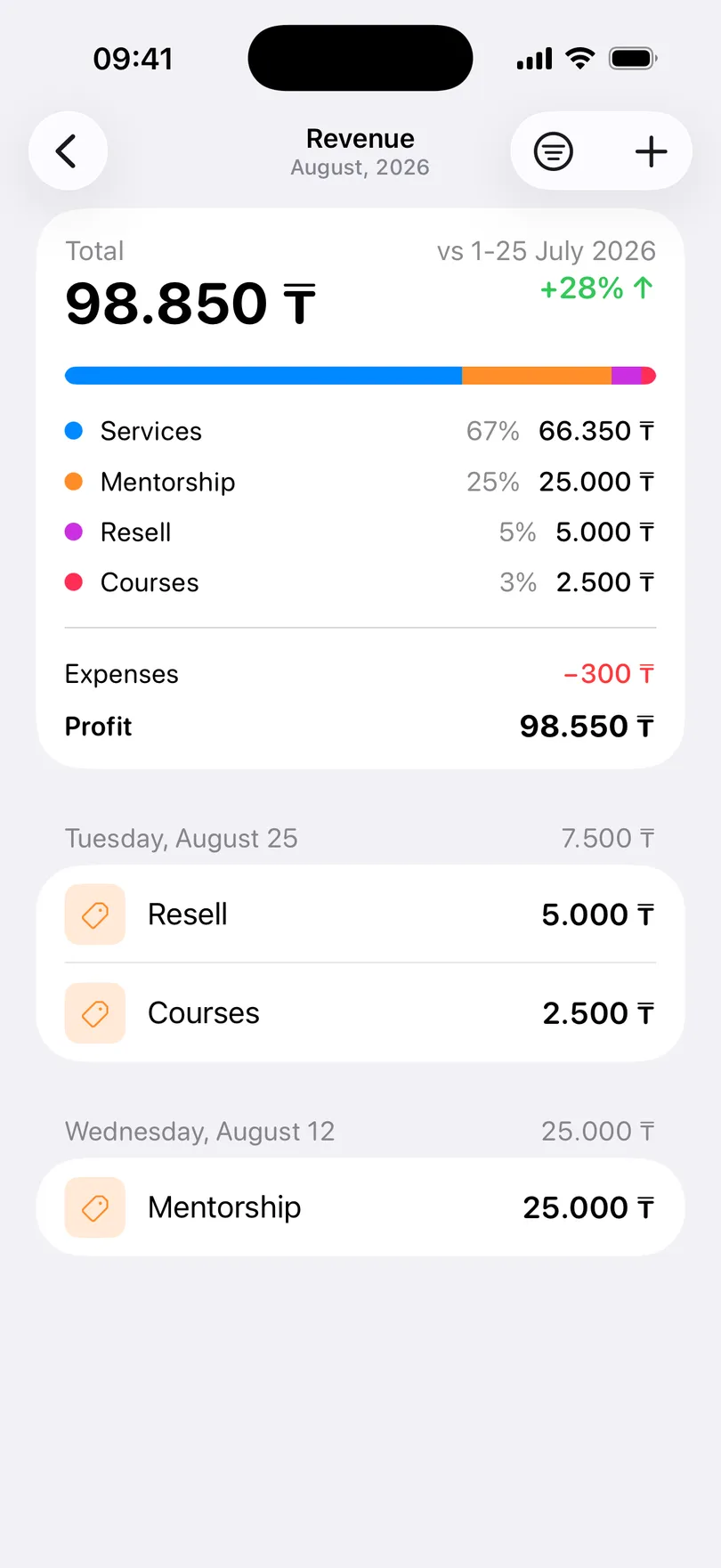
- A source on every entry — named after your actual work, not a fixed list of categories someone else chose
- Percentages beside the amounts — 67 / 25 / 5 / 3 reads faster than four separate numbers ever will
- A comparison with the period before — up 28% on the same stretch of July, with the split showing you which source moved
- Expenses subtracted and profit shown — the amount you keep, not the amount that passed through your hands
- Every entry listed by day — the total stays traceable back to the individual payments that made it
- Offline, like the rest of the app — no account, no connection, nothing leaves your phone
What you do once you can see it
- Grow the efficient stream deliberately. Two teaching days in October instead of one is a decision you can only make if you know what the first one was worth per hour
- Reprice the slow one — or let it go. A stream returning $70 an hour for three hours of handling is worth keeping. The same stream at $12 an hour is a hobby you’re subsidising
- Catch a source while it’s dying. A stream that shrinks three months running is easy to miss inside a total that holds steady, and obvious the moment it has its own line
- Plan the quiet season. Every solo business has one. Knowing which stream still pays in August is what makes August survivable
- Price a day off honestly. A missed teaching Saturday and a missed client Saturday cost very different amounts
So — what earned it?
At the end of next month you’ll get a total, the way you always have. What’s new is that you’ll be able to answer the second question: which stream carried it, which one is quietly growing, and which one has been occupying far more of your attention than of your income.
That’s the more useful question. It’s also the one that changes what you decide to do in September.
Revenue by source arrives in the next My Clients update — free, offline, on the phone you already use to book the work. Same total at the bottom. Finally, an answer to what made it.
Start organizing your clients today