How a Solo Barber Can Manage Regulars, Walk-Ins, and Cash Income — Without an Expensive CRM

Marco rents a chair in a four-chair shop. He has about 80 regulars on a steady rotation, picks up walk-ins between bookings, and works mostly cash. On a good week his chair is busy from Tuesday morning to Saturday night.
Ask him how many regulars haven’t been in for six weeks and he can’t tell you. Ask him what he actually netted last month after booth rent, blades, and oil — and he’ll guess. When Mike, the guy who came in every three weeks like clockwork, suddenly stops showing up, Marco only notices three months later. By then Mike is getting his fade at the new shop down the block.
Marco isn’t bad at his job — he’s brilliant with the clippers. What he’s missing is a system. And that gap is quietly costing him money every single week.
Why Barber Client Management Gets Out of Hand Fast
Barbering looks simple from the outside: client sits down, you cut, they pay, next. The reality of running a chair is messier:
- Mix of regulars and walk-ins — regulars are on a cycle, walk-ins drop in randomly, and both compete for the same time slots
- Cash-heavy payments — by Saturday night, you can’t remember what came from cuts, what came from tips, and what’s already gone to lunch
- Bookings everywhere — texts, Instagram DMs, “I’ll just stop by,” shop landline, occasionally a website
- Booth rent is fixed — every empty chair-hour is a direct hit to your take-home, not a “missed opportunity”
- Service combos vary — a basic cut, a cut + beard, a fade + line-up + hot towel all take different time and earn different money
- Tipping math gets fuzzy — especially around tax time
An empty chair for a $35 cut isn’t a “$0 day.” It’s $35 you already paid booth rent for. Empty chairs cost real money.
The Hidden Cost of “I’ll Remember”
The barbers who run their book on memory and a paper notebook all share the same five leaks:
- Regulars drift away unnoticed — a 3-week client misses one cycle, then two, then they’re gone. By the time you wonder where they went, they’ve found a new chair
- Walk-ins go unlogged — three quick cuts on a busy Saturday turn into “I think I made around $100” instead of $135 + tips
- Underpriced combos — you quote $20 for a beard add-on because you can’t remember the price, when it should have been $25. That’s a 20% leak
- Double-bookings on Saturday — two regulars assume the same 2 PM slot because one texted, one said it last week
- No follow-up — a client says “I’ll book the next one when I leave” and walks out. You forget to confirm, they forget to book, six weeks pass
A solo barber doing 30 cuts a week at $35 earns about $1,050 before tips. Two empty slots per day is an 8-cut deficit — roughly $280 a week, $1,200 a month of pure ceiling you’re leaving on the table.
What a Solo Barber Actually Needs
Most “barber software” comes from companies trying to sell you a salon platform: online booking pages, staff management, marketing dashboards, payment processing. You pay $30–$70 a month and use about 10% of it.
Here’s the short list of what actually matters when you’re behind one chair:
- A clear daily view of who’s coming in, what service, and what time
- Client cards with cut spec — fade level, scissor or clipper top, beard line, allergies, conversation hooks
- Quick add for walk-ins — two taps to log a cut, price, and tip while the next client is sitting down
- Reminders for you — a day-before heads-up on your phone, plus an at-a-glance view of tomorrow
- Income tracking — gross, tips, expenses, average ticket, and what you actually take home
- Offline access — shop Wi-Fi flakes, you work guest spots, you don’t want a spinning wheel between clients
- No subscription, no account — your client list isn’t on someone else’s server
That’s the whole list. A tool built around those six things replaces the notebook, the spreadsheet, the group chat, and the $50/month CRM in one shot.
Client Cards: Treat Every Regular Like a Regular
The reason a client comes back to you instead of the kid down the street isn’t price. It’s that you remember. You remember he runs a 1 on the sides, scissor on top, taper to skin at the neckline. You remember his wife teaches third grade. You remember his son just made varsity.
A client card should hold:
- Cut spec — clipper guards, scissor work, fade level, neckline finish
- Beard preference — length, hard line vs. soft line, shape
- Visit cadence — every 2 weeks, 3 weeks, 4 weeks
- Conversation hooks — kids, work, hobbies, last vacation
- Allergies and skin notes — sensitivity to certain oils or aftershaves
- Last service and date — so you know when they’re due
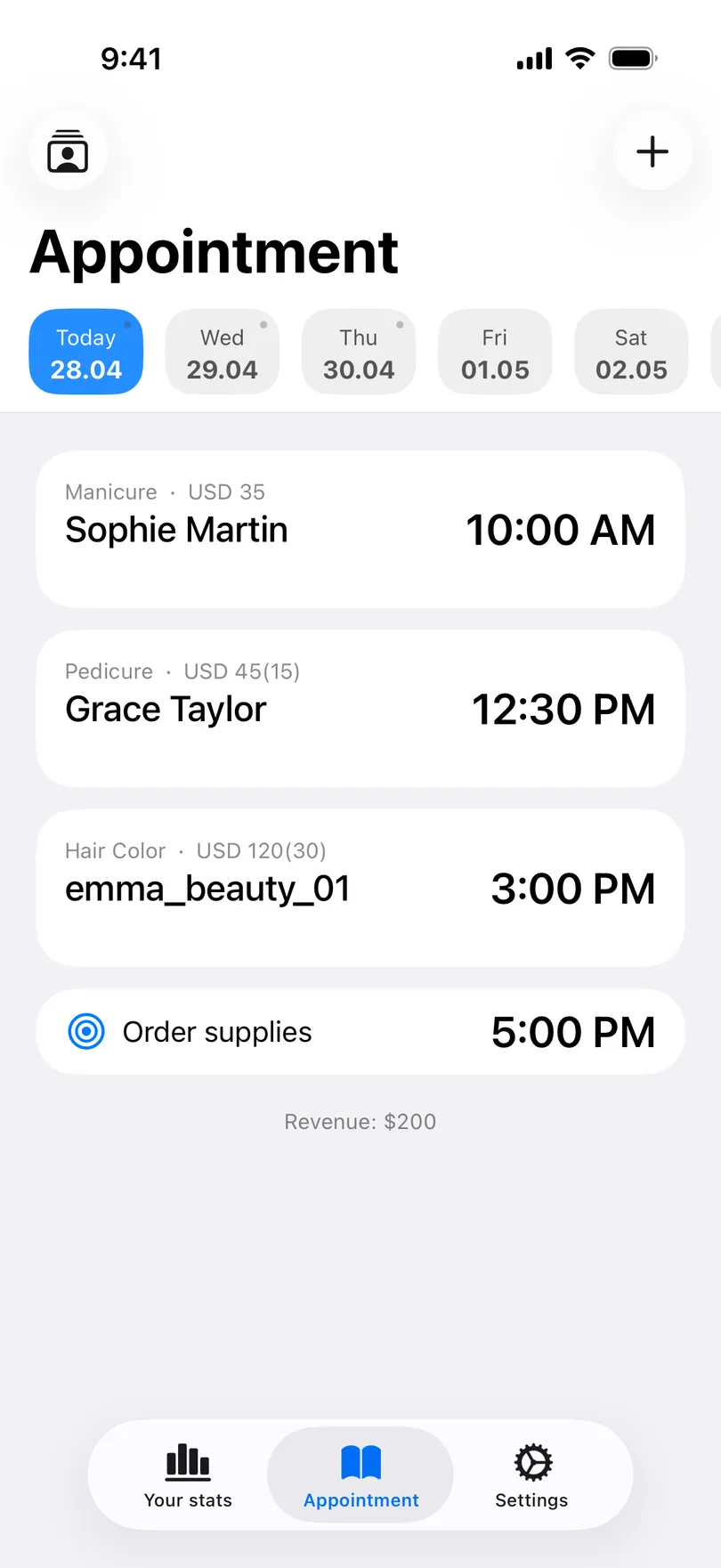
When Mike sits down, you open his card on your phone, glance at the spec, and the conversation flows. That’s why he tells his coworkers about you. Every client card is a small referral engine.
The barber who remembers the cut and the kid’s football team is the barber a regular brings his brother to. The notebook can’t do that. Your phone can.
Reminders That Bring Regulars Back on Cycle
Most “lost” regulars aren’t unhappy. They got busy, missed a cycle, and you weren’t visible enough to remind them.
A push reminder to you the day before changes the math:
- You send a quick nudge — a day-before “see you tomorrow at 4” turns the client’s “I forgot” into “I’m on my way”
- You see tomorrow at a glance — last cut to first cut, with the right cape and pomade ready
- Cancellations come earlier — a client who reschedules at 6 PM gives you the whole next day to fill the slot
- The cycle stays tight — every 3-week regular stays a 3-week regular, instead of slipping to 4, then 5, then gone
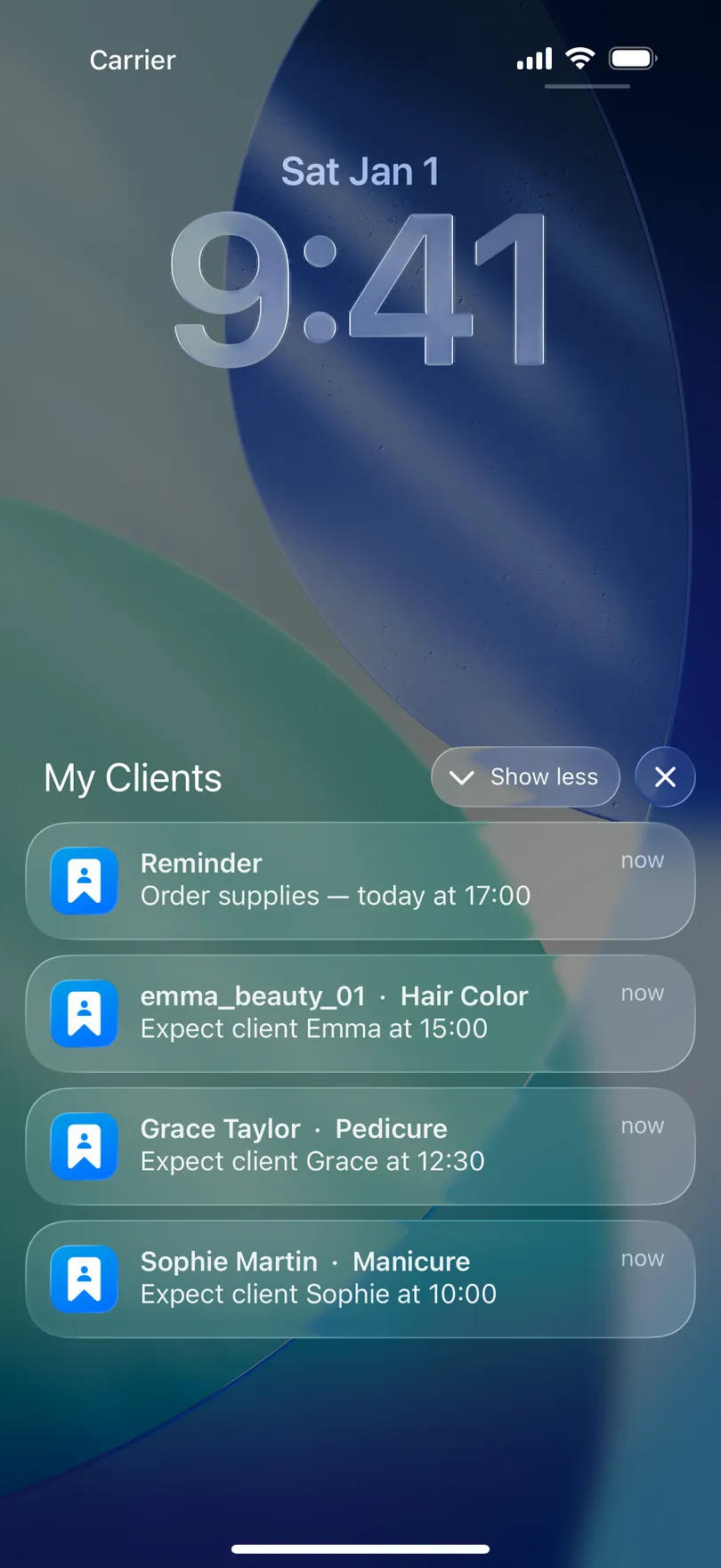
One nudge a day before, one quick call when a regular’s overdue — that’s the difference between a 12-month relationship and a 5-year one.
Know Your Real Income — Cash, Card, and Tips
“Busy” isn’t a number. “Around four grand a month” isn’t a number either. To run a chair like a business you need real numbers — the kind that tell you whether you can afford to raise your rates, swap booths, or buy that new pair of shears.
A simple income screen gives you:
- Total monthly income — every cut you logged, summed automatically
- Tip line — separate from service revenue, so taxable income stays clear
- Expenses — booth rent, blades, oil, capes, pomade, towels, business cards
- Average ticket — a quick signal if you’re undercharging the combo
- Working days — how many days you actually cut hair this month
- Net profit — the number that lands in your pocket after everything
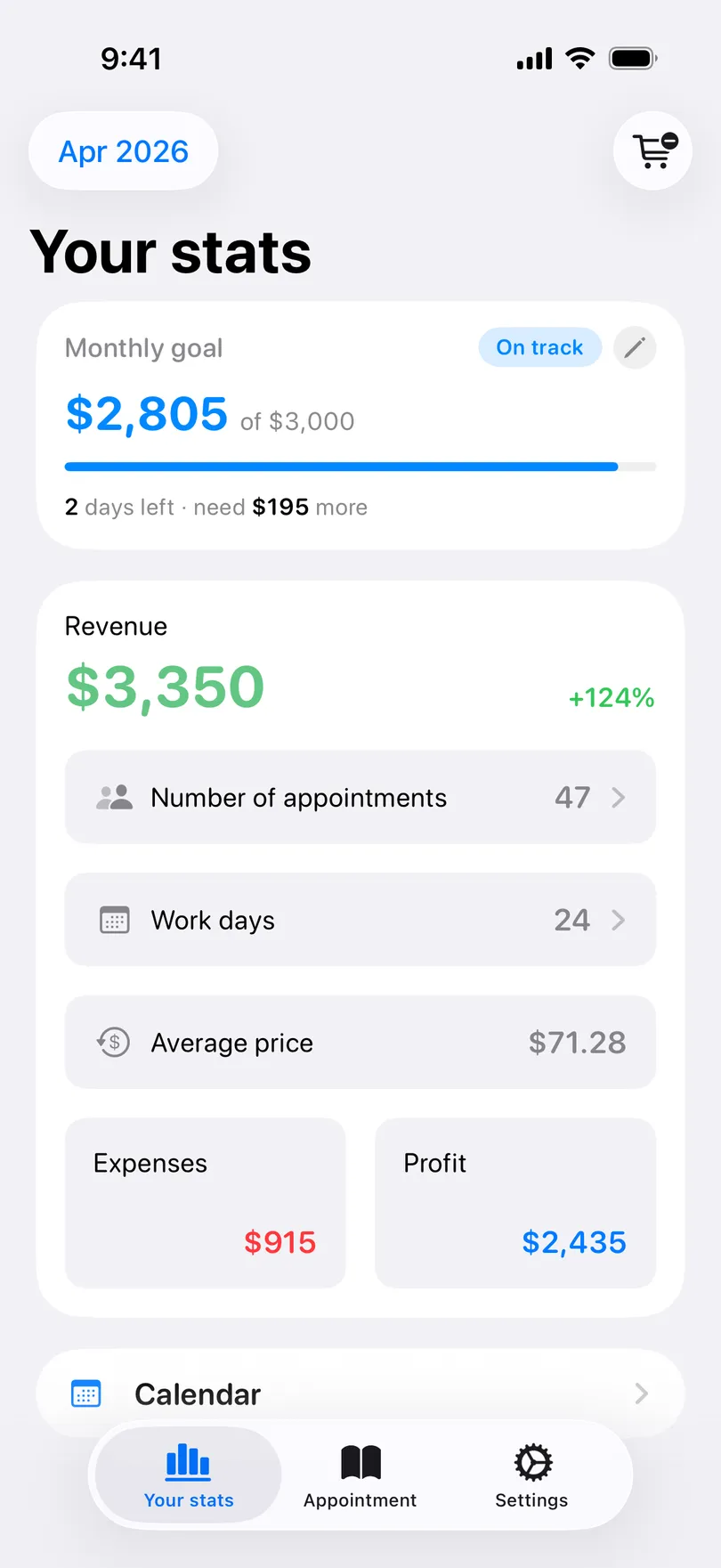
A barber who thinks he earns $4,000 a month and discovers it’s actually $4,800 has just found 20% more leverage at booth-rent renewal time, or 20% he can save, or 20% he can put into better tools.
Works on Any Chair, in Any Shop, with Any Signal
Booth renters move shops. Mobile barbers travel. Some guys cut at home on Sundays. Some take guest spots in another city for a weekend. The shop Wi-Fi goes down once a week, usually mid-cut.
An offline-first app doesn’t care:
- Everything stored locally on your phone, no cloud, no account
- Works in airplane mode — guest spots, conventions, basements, no problem
- No login — install, open, start booking, no password to forget
- Your client list moves with you — change shops, change cities, your book is still on your phone
- No data leaks — there’s no server to hack, no company holding your regulars hostage behind a subscription
Your client list is your business. It doesn’t belong on a server you don’t control or behind a subscription that can lock you out at the worst time.
Before and After: Marco’s Story
Before — a paper book, group chats, and memory:
- 80 regulars, 12–15 quietly drifting off cycle every month, mostly unnoticed
- 3–4 no-shows a week, no reminders sent, no pattern visible
- Walk-ins logged “later” — and “later” never came
- Saturday rush: 1–2 double-bookings a month, awkward apologies, lost trust
- Income guess: “around $4,000, give or take”
- Booth rent due on the 1st: vague stress, no math behind it
After — three months with a client app:
- All 80 regulars in one place with cut spec, cadence, and conversation notes
- Day-before push reminders for every booking
- Walk-ins logged in two taps the moment they pay
- Visit history per client made it obvious who hadn’t been in for 6+ weeks
- Marco called 14 lapsed regulars over two weekends — 11 came back
The results
- No-shows dropped from 12–16 a month to 3–4
- Recovered roughly $700 a month in regulars who would have drifted
- Walk-in revenue logged for the first time — $300/month he was already earning but couldn’t see
- Saturdays calm — zero double-bookings since switching
- Real monthly income revealed: $4,750 — almost 20% above his guess
- Spotted that Tuesday afternoons were dead and Saturday mornings were oversubscribed; rearranged the week and added 4 cuts
“Half my ‘extra income’ wasn’t extra. It was just income I never tracked. Once I saw it, I started charging the beard combo properly and stopped giving away the line-up.” — Marco
Who Else This Fits
The same workflow fits any solo professional working a chair, a table, or a single room:
- Hairstylists — color clients, cut clients, mixed cadences
- Lash and brow artists — 2–3 week rebooking cycles
- Barbershop owners renting out chairs — track your own book, leave the rest to your renters
- Mobile barbers — house calls, weddings, photoshoots
- Beard groomers and detail specialists — short, frequent visits
If you book clients, deliver a service, and get paid for it — this is built for you.
Getting Started in Five Minutes
No tutorials, no account setup, no data import:
- Download the app — free, no sign-up, no subscription
- Add your top 20 regulars — name, phone, cut spec, cadence
- Schedule the next two weeks of bookings
- Turn on push reminders so neither of you forgets
- Log every cut as it ends — five seconds, while the client is paying
By the end of the month you’ll know more about your business than you have in years.
A barber’s chair, his clippers, and his client list — that’s the whole business. Keep all three sharp. Try My Clients for free, no sign-up required.
You might also find useful
Start organizing your clients today