Monthly Income Goals: How to Plan Your Month Instead of Working Blind

Katya is a nail tech in her third year solo. End of April she opens her bank app, sees the balance, and thinks: “I think March was bigger.” She checks her records: 42 clients in March, 38 in April. Where did four visits and roughly $300 go?
Sound familiar? Most solo pros count income on the last day of the month — when it’s already too late to change anything. A monthly income goal isn’t about pressure or hustle. It’s about seeing your month before it ends.
Why solo pros work “however it goes”
“However it goes” is the most popular strategy among solo pros. It feels like freedom — but it’s mostly fog:
- You count income after the fact — “feels okay”, “feels low” — but no specifics until the bank statement
- You don’t see the slow days — missed an empty Tuesday, only noticed two weeks later
- You react to the calendar — clients pick the days, not you
- You plan time off blindly — “I think I can afford it” instead of “here’s the number, I can / I can’t”
- You don’t know what a “good month” even is — so every month feels average
If you don’t have an income goal, you don’t have wins or losses either. Just an endless “okay”.
The paradox: to earn more, you don’t have to work more. You have to see the month before it’s over.
A goal is a compass, not a KPI
Income goals get confused with corporate sales targets. It’s not “hit this or you’re fired” — it’s a point you steer towards.
- Helps you decide in the moment — take another client or not, accept a discount or not
- Shows daily progress — you see whether you’re on pace, without waiting for month-end
- Turns “a lot / a little” into a number — fact instead of feeling
- Removes anxiety — if you’re on plan, no panic after a slow Friday
A goal isn’t pressure. A goal is permission to work calmly because you know where you stand.
How to set a real goal
Not “I want $5,000” out of thin air. A real goal is built from your data:
- Take the average revenue from the last 3 months — your honest baseline, no illusions
- Add 5–15% — not more (you’ll burn out), not less (no point)
- Account for the month’s context — holidays, time off, seasonality. May is peak for nail techs; August is a slump
- Divide by working days — that’s your daily target. Not a hospital average, a real “today I need” number
- Write it down — in the app, in notes, on a sticky. Without writing, the goal doesn’t exist
A solo pro who averages $3,200/month sets a goal of $3,500 (+10%). With 22 working days, that’s $160/day — concrete, not abstract.
Calendar load: where the slumps are and where the heat is
Once the goal is set, you need the second piece — seeing how things are going right now. Not in two weeks. Today.
In the My Clients app, your goal sits next to your actual revenue. The calendar shows which days were heavy and which were empty — visually, with colored bars under each date:
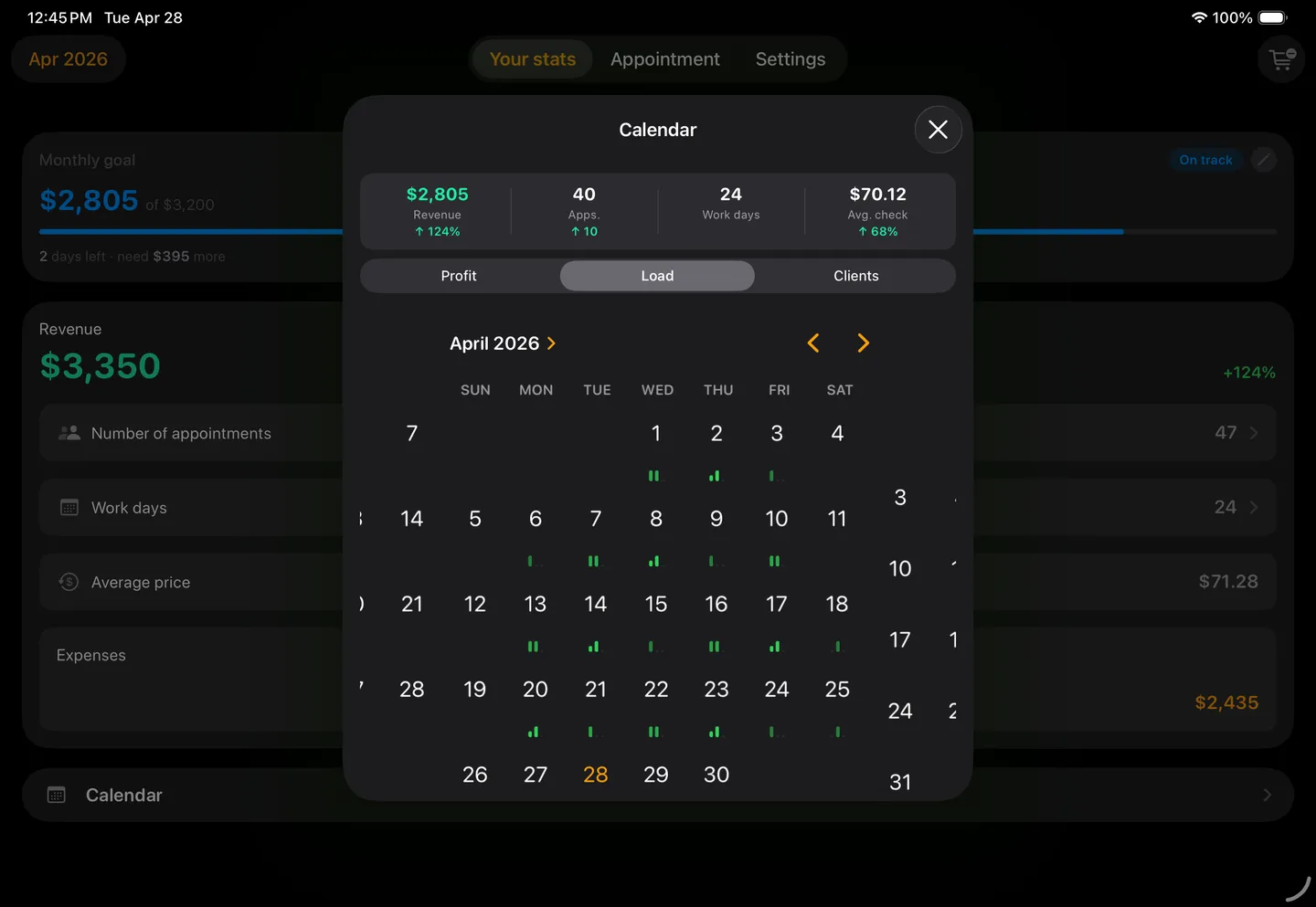
What you see in 3 seconds:
- Goal and current revenue — “$2,510 of $2,900, 2 days and $390 to go”
- Which days were packed — tall bars
- Which days were empty — short bars or none
- Which weekday consistently underperforms — patterns reveal themselves
When you see that Thursdays are consistently slow, it’s no longer a guess. It’s a fact. And you can act on it.
What to do about slow days
Numbers without action are just a pretty picture. Here’s what works:
- Fill the slot with regulars — message 5–10 loyal clients with an opening for that day
- Run a day-specific promotion — “Tuesday is master’s day”: −15% on services before 2pm
- Shift popular slots — if everyone wants Friday, offer some Thursdays with a small bonus
- Take a course or take the day off — if Thursday is consistently empty, schedule it as a day off, no guilt
- Move supply runs and admin work — empty day = time for non-client work, not for scrolling
A slow day isn’t a disaster. The disaster is when you didn’t know it was slow and sat through it on your phone.
Before & After: Katya’s story
Before — no goal, no plan:
Katya worked “however it goes” for three years. Income swung between $2,700 and $3,800 with no clear reason.
- Tallied results on the last day of the month, sometimes surprised
- Didn’t notice that Tuesdays were consistently 40% under-booked
- Took her vacation in May — the highest-revenue month for nail techs
- Discounted on any random day because “I’m not doing anything anyway”
- Lost an estimated $500–$900/month to empty slots and badly-timed discounts
After — a goal and the calendar at hand:
Katya set a goal of $3,600/month — based on her trailing quarterly average plus 12%.
- Every morning she sees how much is done and how much is left to goal
- Spotted the “empty Tuesday” pattern in 2 weeks — moved it to her day off
- In May, seeing a packed calendar, added Saturday slots instead of taking time off
- Moved her vacation to August (low season) — no income hit
- Revenue went from $2,950 to $3,750 over 3 months
“I’m not working more. I’m just no longer sitting through empty days on my phone — I’m either resting or taking the extra client. The goal doesn’t pressure me. It frees me.” — Katya, nail tech
Don’t let the goal become a tyrant
The most common mistake is turning the goal into a whip. Don’t:
- Missed $3,600? Not a failure. Data for next month
- Life changes — got sick, traveled, moved studios. The goal moves too
- Don’t compare yourself to other people’s numbers — different services, different rhythm, different situation
- The goal is for you, not for social media — you don’t have to show it to anyone
- One bad month doesn’t decide anything — look at the 3–6 month trend
A goal is a tool. The moment it stops helping and starts hurting — adjust the goal, not yourself.
Bottom line
Working without a goal is working in fog. Money comes in, but you don’t know what to do with it or how to steer it. An income goal is a simple tool that turns “however it goes” into a process you control:
- Set a realistic number — 5–15% above the trailing 3-month average
- Divide by working days — get a daily target, concrete and clear
- Watch the calendar load — see slumps, peaks, and patterns
- Act on slow days — regulars, promotions, scheduled time off, admin work
- Don’t turn the goal into a whip — it’s a compass, not a stick
Most solo pros don’t earn what they could — not because they don’t work hard, but because they don’t see their month until it ends. A goal plus a calendar load view are the two simplest tools to fix that.
Try the My Clients app — free, no signup. Set a monthly income goal, track your daily progress, and see your calendar load at a glance — on iPhone and iPad.
You may also like
Start organizing your clients today