How a Solo Lash Artist Can Keep Clients on the 3-Week Cycle, Cut No-Shows, and See Her Real Income

Lena rents a small room in a beauty studio. She has about 60 lash clients on rotation — full sets, infills every two to three weeks, the occasional removal. Her bookings live in Instagram DMs, her lash maps live in her memory, and her schedule lives in a paper planner with arrows and crossed-out names.
This morning her 9 a.m. didn’t show. Not a 30-minute brow tint — a 2.5-hour full set she’d turned two infill requests away for. And while she sat in the empty room scrolling her DMs, she realized something worse: Kate, who came every three weeks like clockwork for a year, hasn’t been in for seven. Lena never noticed her go.
Lena’s hands aren’t the problem — her retention is famous in three neighborhoods. What she’s missing is a system built around the one thing that makes lashes different from almost every other beauty service: the clock.
The Lash Business Runs on a Three-Week Clock
Natural lashes shed. Whatever you build on them sheds too. That’s why your entire income runs on a cycle most other solo pros don’t have:
- The infill window is hard — at 2–3 weeks a client needs an infill; past 4–5 weeks there’s too little left to fill, and it becomes a full set again
- A slipped cycle isn’t neutral — the client either pays full-set price (and feels it), or quietly decides lashes are “too much hassle” and stops altogether
- Your calendar compounds — every client you keep on cycle books herself 15–17 times a year without you selling anything
- Cycle slip is invisible — nobody announces “I’m drifting.” They just book at 3 weeks, then 4, then 6, then never
A client on a 3-week cycle visits about 17 times a year. The same client slipping to 5 weeks visits 10. At $65 an infill, that one quiet slip costs $455 a year — per client. Five slipping clients is $2,275 you never see leave.
This is the core of lash client management: it’s not about storing phone numbers. It’s about protecting the cycle.
Where the Money Quietly Leaks
Run the book on DMs, memory, and a paper planner, and the same five leaks show up:
- Regulars drift off cycle unnoticed — like Kate. By the time you wonder where she went, she’s either lashless or on someone else’s lash bed
- No-shows hit harder than in any other niche — your slots are 75 minutes to 2.5 hours. One ignored reminder doesn’t cost you an appointment; it costs you a third of the working day
- Lash maps live in your head — curl, thickness, length map, style. When memory blurs, the set comes out “a bit different,” and clients notice “a bit different” on their own face immediately
- Sensitivities go untracked — the client whose eyes watered with one glue, the one who needs foam-free cleanser. One forgotten note is one red-eyed client who never returns
- Income is a guess — full sets, infills, removals and retail all blur into “around $2,800, I think,” while glue, lashes, and pads quietly eat the margin
A no-show on a 30-minute appointment stings. A no-show on a 2.5-hour full set is $120 you planned around, gone with one ignored DM — plus the two infills you turned away for that slot.
What a Solo Lash Artist Actually Needs
Salon platforms will happily sell you online booking pages, staff rosters, marketing funnels, and payment processing for $30–$70 a month. Behind one lash bed, you’d use a tenth of it.
The real list is short:
- A clear daily view — who’s coming, full set or infill, how long the slot really takes
- Client cards with the lash map — curl, thickness, lengths, style, glue notes, retention quirks
- Visit history per client — so “due for an infill” is a fact you can see, not a feeling
- Push reminders — because a forgotten infill doesn’t just cancel a visit, it resets the client to a full set
- Income and expense tracking — sets vs. infills, plus the supplies bill that lash work quietly runs up
- Offline, on your phone, no account — your client list stays yours, works in any studio, basement room, or home setup
That’s the whole job description. One simple app that does these six things replaces the planner, the DM scroll, and the salon platform you were never going to grow into.
Client Cards: The Lash Map Lives on the Card, Not in Your Head
Ask any lash client why she stays with her artist and you’ll hear the same thing: “She knows my eyes.” The set fits her face, the curl suits her lid, nobody has to re-explain anything. That knowledge is your moat — as long as it’s written down.
A lash client card should hold:
- The map — curl (C, CC, D), thickness, lengths by zone, style (classic, hybrid, volume; cat-eye, doll)
- Glue and sensitivity notes — watering, redness, which adhesive worked, patch-test date
- Retention quirks — oily lids, sleeps face-down, sauna and pool habits — the clients who genuinely need a 2-week cycle instead of 3
- Visit cadence and history — every visit with date, service, and price
- Personal hooks — wedding coming up, new job, kids’ names. Two hours of conversation is part of the service
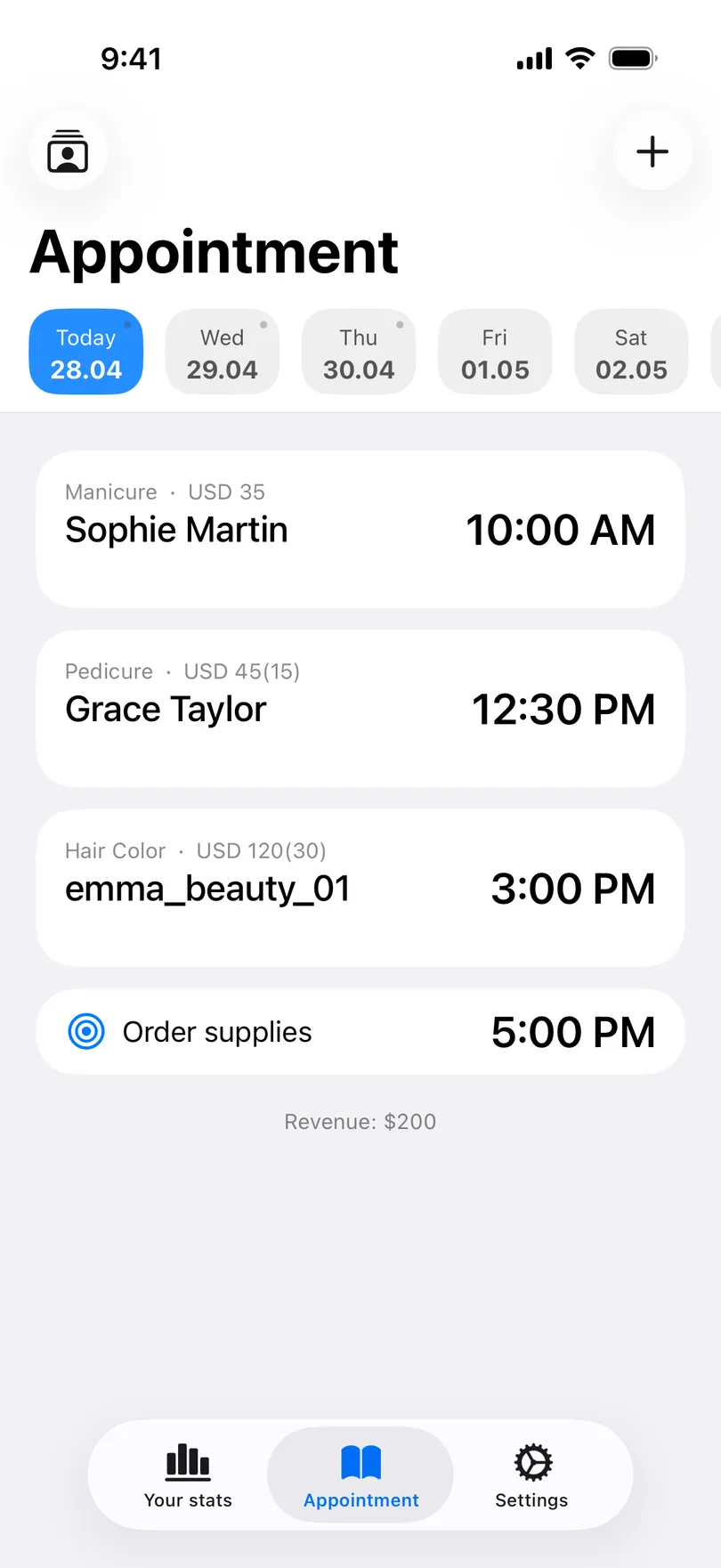
Next visit, you open the card, glance at the map, and start mixing — no “remind me, what curl did we do?” The set comes out identical to the one she loved.
The artist who remembers the map, the glue that didn’t itch, and the wedding date is the artist clients bring their sisters to. A client card is a small referral engine.
Reminders That Protect the Infill Window
Most lapsed lash clients didn’t leave you. They missed the infill window, faced a full-set price to come back, and quietly opted out. The fix is making sure the window never closes by accident.
In the My Clients app every booking comes with a reminder for you — you set the lead time once, anywhere from 30 minutes to a day ahead, and it holds for all of them:
- You send a day-before nudge — a quick “tomorrow at 2” turns the client’s “oh no, I forgot” into a confirmed visit
- Cancellations surface earlier — an evening reschedule gives you a whole day to fill a 2-hour slot instead of an empty morning
- The cycle stays tight — 3 weeks stays 3 weeks, instead of slipping toward the full-set cliff
- Rebooking becomes the default — book the next infill while she’s still in the chair, and the app keeps that date in front of you until it’s time to send her the nudge
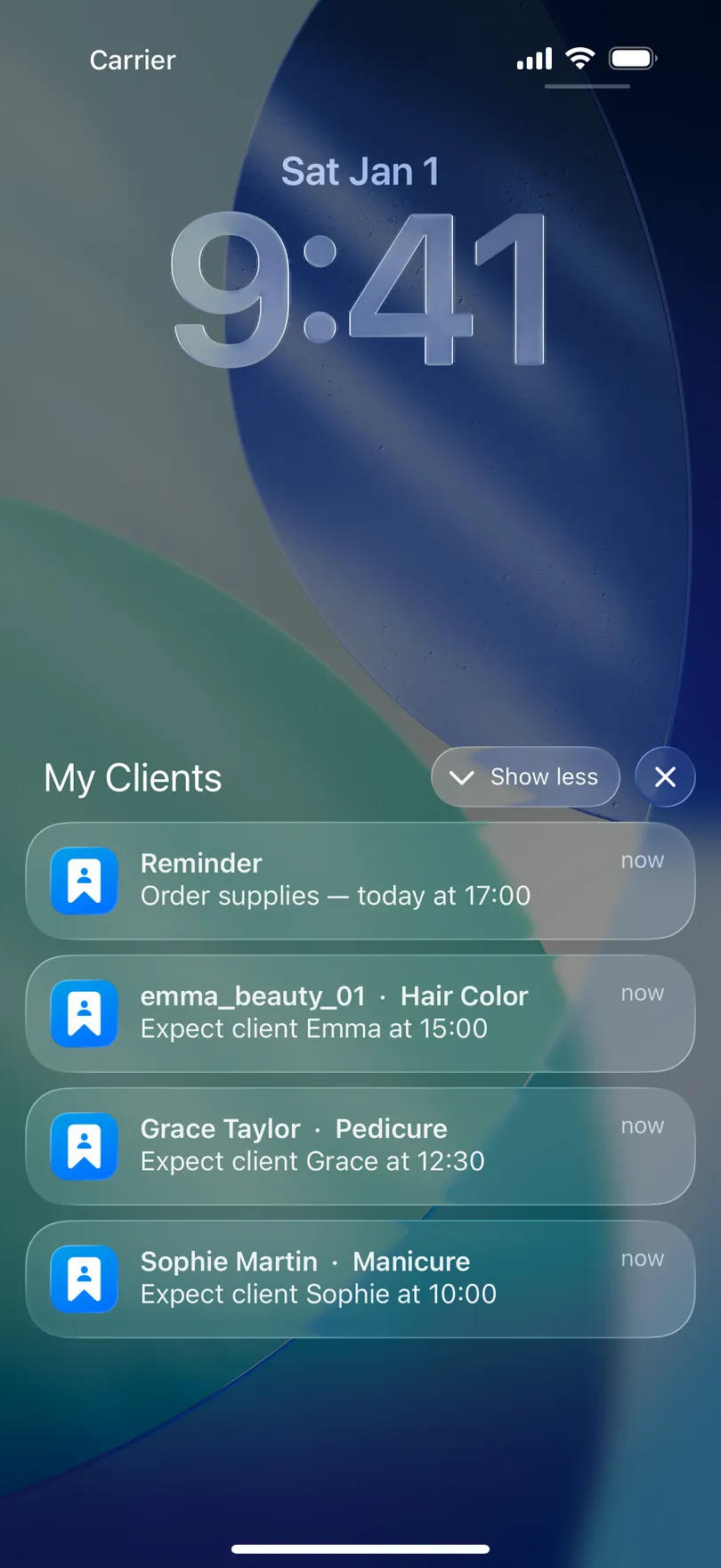
And for the ones who already drifted: visit history makes them visible. Anyone whose last visit is past four weeks is one warm message away — “I have a slot Thursday, want me to top you up before it turns into a full set?” works because it saves her money too.
Know Your Real Income — Sets, Infills, and Supplies
Lash work has a money pattern most artists feel but never see: the counterintuitive math of infills.
A $120 full set takes 2.5 hours — that’s $48 an hour. A $65 infill takes 75 minutes — $52 an hour, with zero acquisition cost and a client who’s already sold. Keeping clients on cycle isn’t just retention; infills are quietly your best-paying service.
You only see this when you track it:
- Income by month — every set, infill, and removal logged in five seconds at checkout
- Expenses — trays, adhesive (which expires whether you use it or not), pads, primer, room rent
- Average ticket and working days — the early-warning signals for undercharging and overworking
- Net profit — the number that actually lands in your pocket
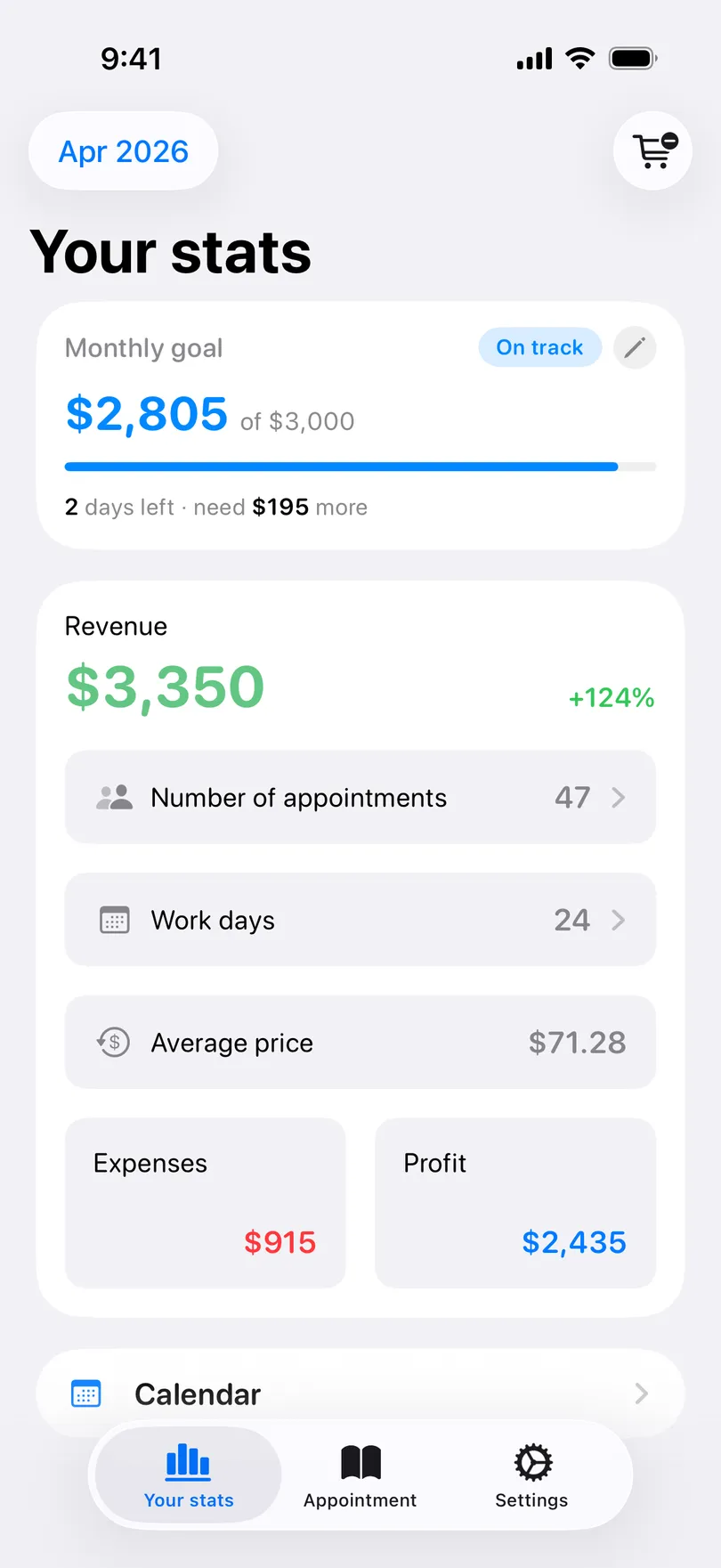
An artist who “makes around $2,800” and discovers it’s actually $3,150 — with $400 of it going to adhesive and trays — has just found real numbers to set prices with, instead of pricing by what the studio next door charges.
Before and After: Lena’s Three Months
Before — DMs, memory, and a paper planner:
- 60 clients on rotation, 4–6 quietly slipping off cycle every month
- 3–4 no-shows a month, most of them long full-set slots
- Lash maps from memory — “a bit different” sets, two awkward re-dos
- Kate-style disappearances discovered months late, or never
- Income guess: “around $2,800” — supplies never counted
After — three months with a client app:
- All 60 clients have cards: map, glue notes, retention quirks, full history
- You get a day-before reminder on every booking; the next infill is booked before the client leaves
- She sorted the client list by who hadn’t been in longest, messaged the 15 past the four-week mark — 8 came back, including Kate
- Every visit logged at checkout; supplies entered as expenses
The results
- No-shows dropped from 3–4 a month to 1, saving roughly $240 in dead slots
- Win-back messages brought $520 in one month — and put 8 clients back on cycle
- Real income revealed: $3,150, not $2,800 — and the supplies bill finally visible
- Saw infills out-earn full sets per hour, and started protecting the cycle like it’s the product — because it is
“I thought I had a memory problem. I had a visibility problem. The moment I could see who was overdue, getting them back took one message.” — Lena
Your First Week with a System
No data import, no account, no tutorial:
- Download the app — free, no sign-up
- Add your 20 most regular clients — name, phone, and the lash map while it’s fresh
- Book the next two weeks and turn on push reminders
- Log every visit at checkout — five seconds while she checks her lashes in the mirror
- Rebook each client before she leaves — the reminder will do the rest
By your second tray of adhesive, you’ll know exactly who’s due, who’s drifting, and what you really earn.
Your hands fill the lashes. Let the app guard the clock. Try My Clients — free, no sign-up, works offline, and your client list never leaves your phone.
You might also find useful
Start organizing your clients today