The Holiday Rush Is Six Weeks Long. What You Decide Now Is What January Pays You

December 21–24: 22 appointments, $1,320. Four days.
January 12–18: 7 appointments, $420. Six days.
Same clients, same price list, three weeks apart. The second line gets explained away every year — everyone’s broke after Christmas, everyone’s on a diet, January is always like this.
January is not always like this. Most of that week was decided back in October and November, in four or five small moments that didn’t feel like decisions at all.
Six weeks, not one busy week
Ask a solo pro when the holiday rush happens and you’ll hear “December.” Open an actual calendar and it’s longer than that, and much lumpier.
From mid-November to New Year’s Eve you have roughly six weeks, and they are not one continuous wave:
- Mid-to-late November — party season opens, Thanksgiving week squeezes a full week of work into three days, and the first “can you fit me in before Christmas?” messages arrive
- December 1–14 — the quietest stretch of the whole six weeks, because your clients are saving their appointment for later
- December 15–20 — everything that was being saved arrives at once
- December 21–24 — four days that people will beg you for
- December 26–30 — dead in most trades, busy in a few — hair and nails before New Year’s Eve, very little else
- December 31 — one short, expensive day
- January 1–10 — silence, and you’ll want it to be silence
Six weeks, four different shapes: a soft opening stretch, two hard peaks, and a cliff behind them. Every one of the four needs a different decision from you, and three of the four have to be made in advance.
Close the days before you open the book
The order matters more than anything else in this article, and almost everyone gets it backwards.
The usual sequence is: open December, fill December, then look for a day off in what’s left. There is nothing left. The 23rd has gone, the Saturday before it has gone, and the two days you wanted for your own shopping and your own family are now somebody’s root touch-up.
So go the other way round. Before you tell one client that December is open, walk from mid-November to early January and mark the days you are not working:
- Anything that already has a plan on it — the school concert, the drive to your parents, the day your own hair gets done
- One day on either side of the peaks — the 21st to the 24th will overrun, and it needs somewhere to overrun into
- The 25th and 26th, unless you’ve genuinely decided to work them rather than drifted into it
- Three days in the first week of January — you will not make this decision well on January 2nd
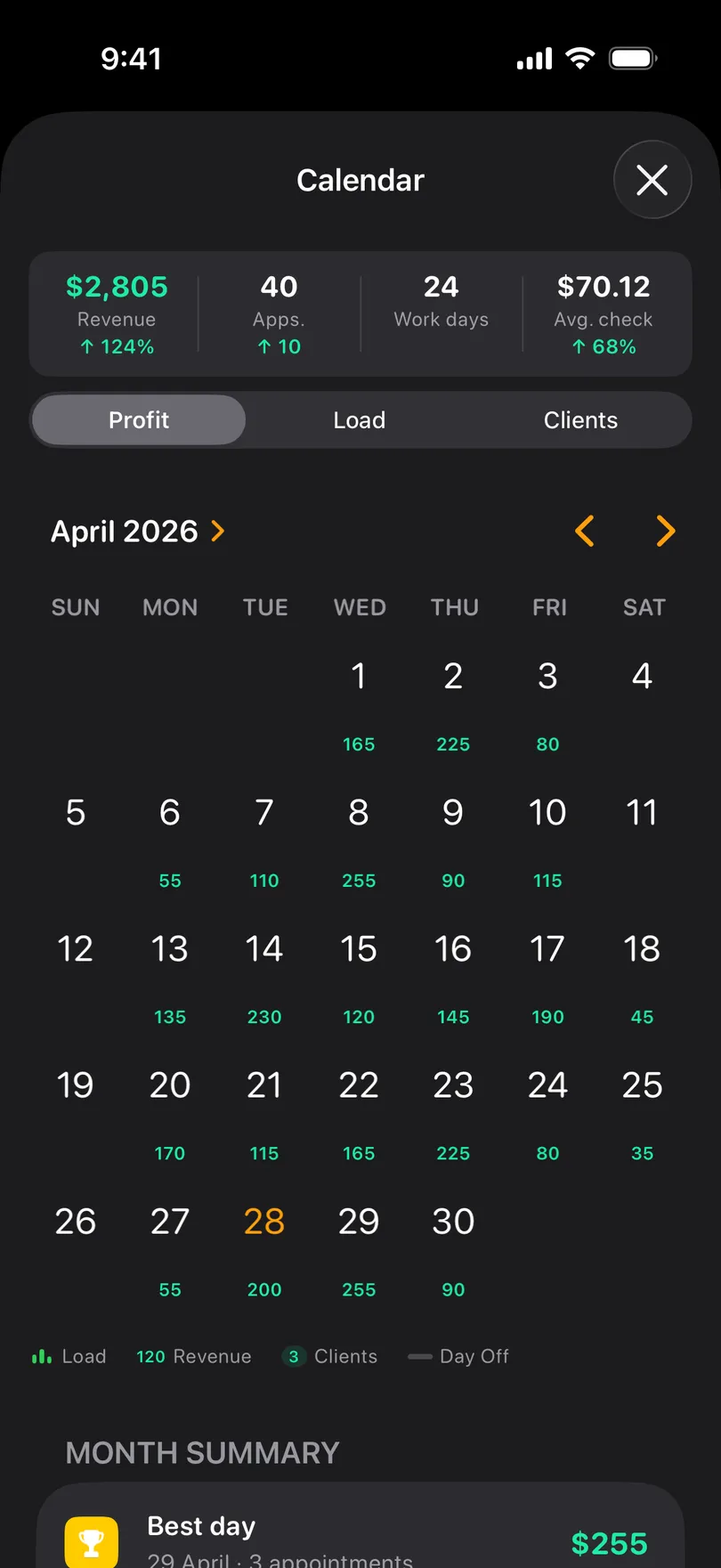
Touch and hold a day in the date strip and tap Mark as Day Off. The calendar then draws a line across that cell, so the shape of your season is visible before it fills (how to mark a day off).
There’s a small detail in there that does the arguing for you: a day can only be marked off while it’s still empty. Once a booking lands on it, the option isn’t offered any more. Which is precisely the situation you’re trying to avoid.
Open December in October — in three passes
Once the closed days are in, there’s a strong temptation to release everything at once and enjoy the feeling of a full diary by Halloween.
Resist it. A diary that fills in a single week in October is a diary you will spend all of November rearranging. Shifts move, family plans change, a flight gets rebooked — and every reschedule inside a full book is either an evening of calendar Tetris or a regular told there’s no space while an unfillable gap sits three days away.
Release it in passes instead:
- Late October — regulars only. Message the people who come every three or four weeks and offer them the dates that match their rhythm. Both dates, not one. Nobody else sees the diary yet.
- Early November — everyone else. Open the rest publicly. By this point the spine of the month is already in place and the awkward gaps are the ones strangers can fill.
- Late November — the last four days. Deliberately hold back a slot on the 22nd and the 23rd until the last two weeks. That’s the slot you can price properly, and it’s the one you hand to the client who would otherwise be turned away in tears.
The two weeks nobody fills
This is the part that costs the most and gets the least attention.
In most solo practices, the first two weeks of December run quieter than an ordinary two weeks in October. Demand hasn’t dropped — your clients are holding out on purpose, so the color, the nails, the lashes are fresh for the 24th.
Which leaves you with the worst possible arrangement of the same demand: eight appointments short in the first half of your best month, and more people than you can physically see in the last week of it.
Two things fix it, and both have to be said out loud, because no client works it out unprompted:
- Give a reason with the early date. “Come in on the 9th and again on the 23rd” is a proposal about how she’ll look on Christmas Day. “I have space on the 9th” is a request for more of her money.
- Offer those two weeks to the people who stopped coming. Filter your client list by Visit frequency → Lapsed — no visit for 90 days or more — and you’re looking at clients who were regulars in the spring and went quiet in the autumn (how to filter your client list)
“I’ve got the 9th at 2pm free — worth coming in before the mad week so you’re sorted for Christmas Day, and I’ll hold the 23rd for a proper redo if you want it. Both?”
Six answered messages is six appointments in two weeks that were going to sit half-empty. And a client who comes back in December, when your work is on show at every party she goes to, tends to still be coming back in February.
Six weeks hold two visits — most regulars book only the second
A client on a three-week cycle has room for two appointments between 20 November and 31 December. Almost none of them book two.
That’s the mechanism behind the thin first half of December, and it’s worth seeing as a number instead of a feeling. Forty regulars on a three-week rhythm is eighty possible visits across the six weeks. Sixty-two is an honest count of what actually gets booked. The other eighteen aren’t lost clients — they’re clients who came once instead of twice, in the six weeks of the year when they most wanted to look good.
Eighteen visits at $60 is $1,080 sitting inside the season everyone calls their busiest — eighteen bookings that nobody ever got around to asking for.
The asking is the entire job, and it takes about eight seconds while she’s still paying: “you’re due again on the 23rd — shall I put you in before it goes?”
The four days people will beg you for
By the third week of December your day list stops being a plan and turns into a negotiation. This is where a good season becomes an exhausting one, and it usually happens through four small habits.
- Look at the day before you answer the message. One glance tells you whether you’re adding a client or adding an hour of unpaid overtime to a day that’s already eleven hours long.
- Keep one slot empty on each peak day. It absorbs the overruns, and when it isn’t needed for that it’s the slot you can give to the person who’d otherwise be turned away.
- Two bookings can land in the same slot. My Clients saves both without complaint — they simply sit one under the other in that day’s list. In March that’s an awkward message. On the 23rd it’s a client watching you apologize to someone else, and she doesn’t come back.
- Ask for a deposit on the peak dates only. Not as a policy for the whole year — as a filter for the four days you can’t afford to have a gap in.
The Prepay field sits next to the price on the appointment. The app doesn’t take the money — cash, transfer, card at the counter, exactly as before — it records what’s already in and shows the price with the deposit in brackets, so the day’s list tells you at a glance who has paid what. Which is all you need on a day with eleven names on it.
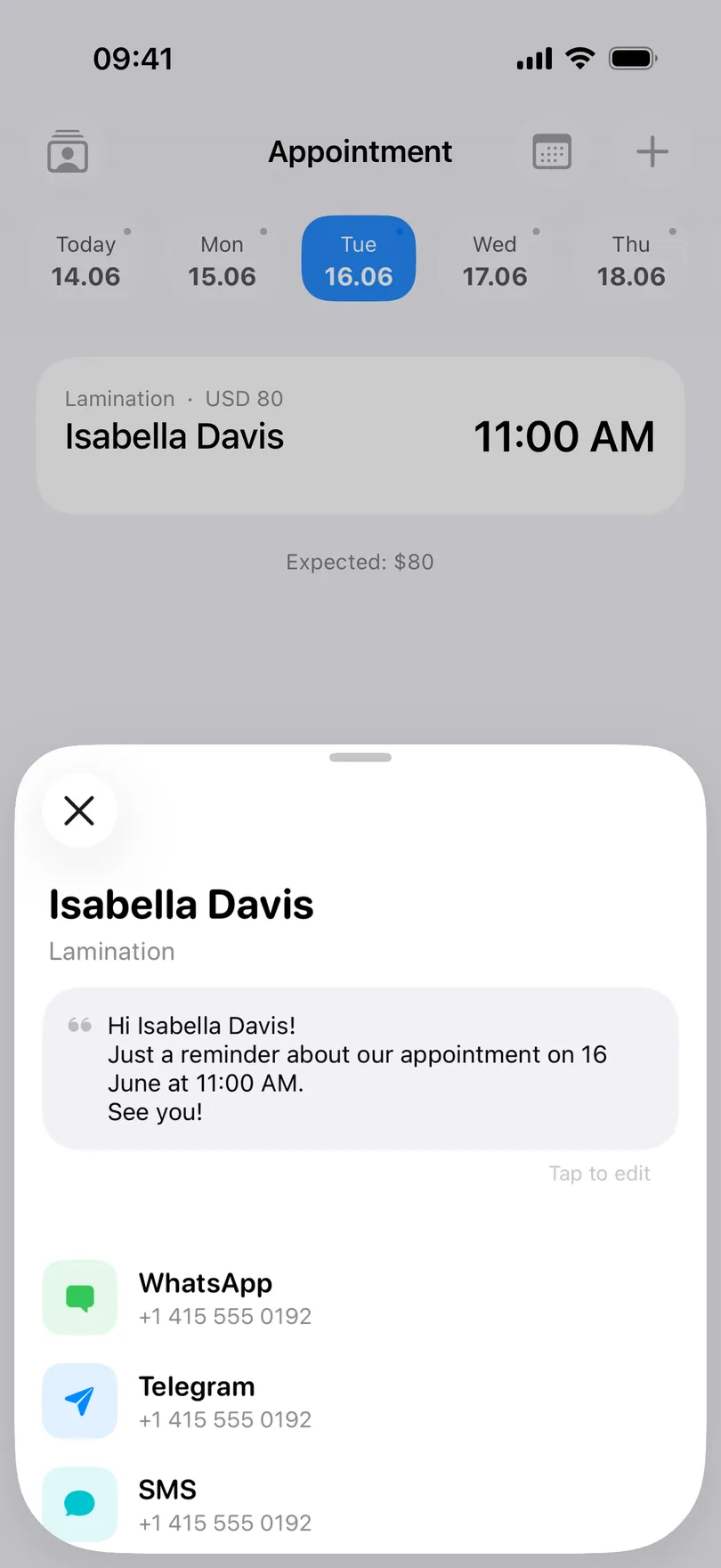
And the confirmations. Your phone reminds you of tomorrow’s appointments, then you message the client yourself, from the booking, with the text already written.
Every appointment after the 20th is a January appointment
Here’s the mechanical link between the two lines at the top of this article.
A client you see on 23 December, on a three-week cycle, is due on 13 January. If she walks out without a date, she doesn’t come on the 13th. She comes when she’s recovered, and recovered means February.
Fourteen regulars leaving on the 23rd with nothing booked is $840 that quietly moves out of January — and about half of them will have slipped into somebody else’s chair by the time they feel ready.
So the peak week has one job on top of the work: every person who sits down between the 15th and the 31st leaves with a date in January. Not “message me in the new year.” A date.
January isn’t quiet because your clients ran out of money. It’s quiet because on the 23rd nobody was thinking about the 13th.
What the season leaks, added up
Two figures, and they don’t overlap:
- $1,080 — the second visit inside the six weeks that never got booked, because the ask never happened
- $840 — the January cycle that slipped to February, because the 23rd ended with a goodbye instead of a date
$1,920 on an ordinary $3,400 month is more than half a month’s takings, and none of it was a demand problem. The demand was standing in front of you, holding a phone with an open calendar on it.
If you do one thing this week
Open a calendar — paper, phone, whichever you’ll actually look at — and go from 15 November to 7 January. Mark the days you are not working.
Don’t plan the rush. Don’t write messages, don’t think about prices, don’t count anything. Just close the days. Everything else here gets easier once they’re gone, and not one of them can be claimed back in December.
Try My Clients — free, no sign-up. Mark your days off before the season opens, see the whole month’s load on one screen, and find the regulars who quietly stopped coming.
You may also like
Start organizing your clients today